I am so happy to be in a small town that kind of revolves around its skating rink, in the same way a Canadian town might. Almost all the kids at least learn how to do it. Some are really excellent at it. Family dramas take place along the edge of the ice. People are surprised when I say I'm from Cloudcroft and they don't know me.
We've only been here five or six months, and of course they do know the kids, who are all in school here. For me, though, going down and hanging out in the little fire room, the place you put on your skates, is the one public place where I stop and actually talk to people. It's a friendly town. You can't just walk around and not talk to people.
So there are these issues related to the skating rink. One, if some kids remove the orange cones in order to play a game, does any adult have the right to reprimand them and tell them to put them back on the soft spots on the ice? The other night I actually fell twice, on the soft spots, though it was my own fault, because 1) I hadn't told them to put them back, and 2) I should have known where the soft spots were, since I had seen the orange cones in the first place. Another kid came along and took a huge dive in the same spot; it was his sister, probably, who had removed the cones. I'm not really sure about people's relationships here, so don't quote me on who did it. It was bad enough, at my house, that the girls insisted that it wasn't them, but had to be the other girls, and we let it go at that, as my shoulders are still sore, and I'm a bit crabby about the subject.
Second, there are these signs all over the place, and nobody knows where they came from. I figure, they had to come from the school, but if they did, nobody spoke up and said it. Also, only one, as far as I could tell, was directly related to skating, most seemed to be just general signs. Pretty, and well-made, but not directed at skaters, really. It's a mystery. I'll put the question out there, and answer it later, maybe.
Finally, how does anyone have a clue when it's open and when it's closed? It seems like we've been over a week with temps around 30, above in the day, below at night. Not enough, in my book, to keep the ice good. Somehow they've kept it open anyway. The trouble, says the guy who does the skates, is when there's water beneath the ice. I saw soft spots, which was trouble enough for me, but I didn't see water beneath the ice. We had a couple of good skates in this kind of weather, much to my surprise. So it's the kind of thing, like the hill down to alamo, that you just have to keep watching until you know how it works. People tend to ask me this stuff because I look older and look like I'm part of the furniture. But I'm not, I just got here. I'm glad I'm not in charge, too. That "skate at your own risk" sign is not enough to keep most people at bay.
Saturday, February 4, 2017

Friday, January 20, 2017


Monday, January 16, 2017


Friday, January 13, 2017
Treaty of Guadalupe Hidalgo
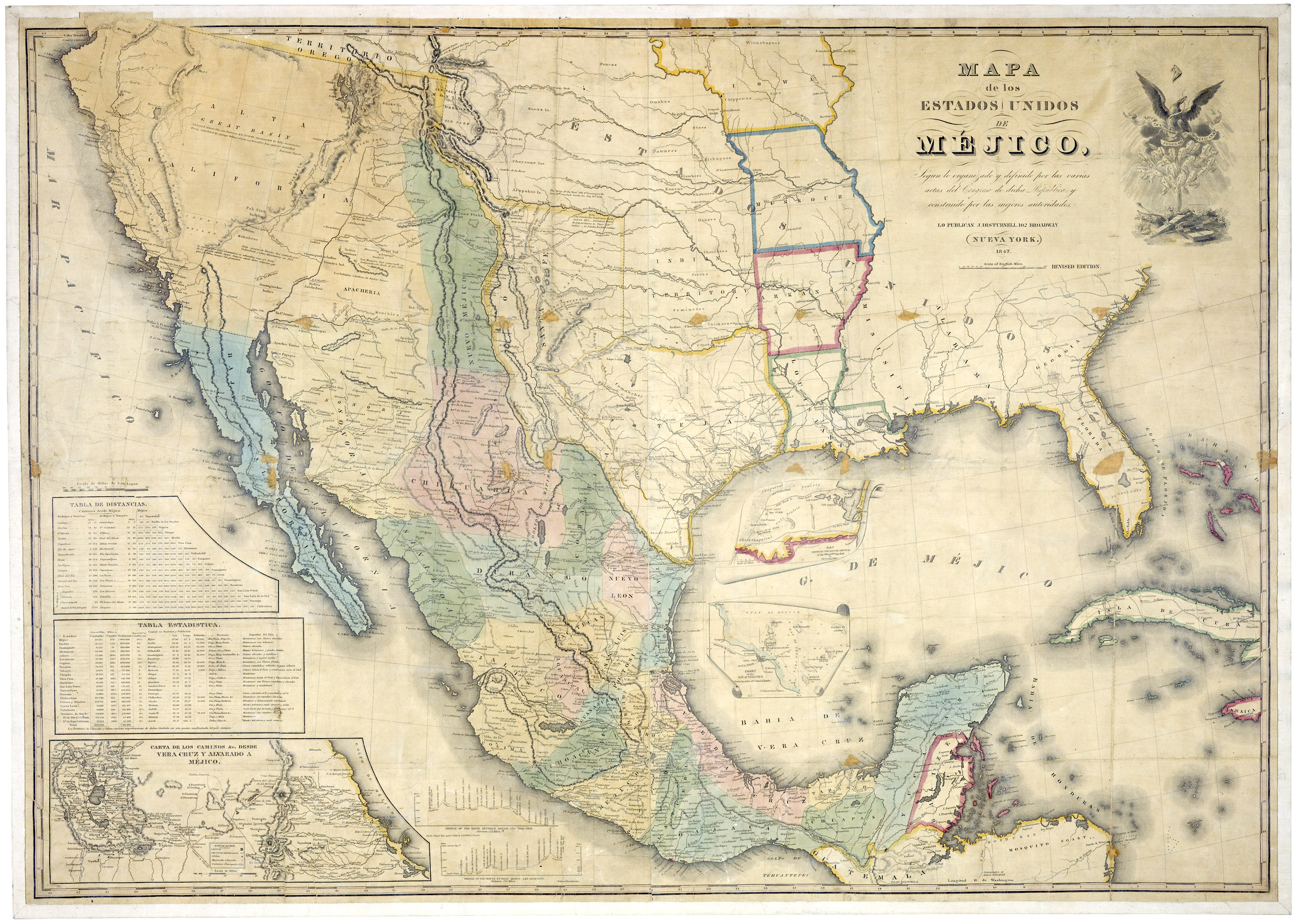
map from wikipedia; cool map isn't it?

map from wikipedia commons also; this one shows the rio grande as the border; we were in "texas"...
Why am I bringing this up now? I was in a history class today and happened to open up a History of New Mexico book; it mentioned this treaty in passing. I remembered it from a claim in a book, Language Loyalty, that as part of this treaty, we had promised Mexican families, who had been in New Mexico forever, the right to keep their language and culture, and property, as part of becoming US citizens. They were also offered a fast track to citizenship, which was a big deal in those days, as many blacks who had come from the South still didn't have it; and, a number of immigrants from other places, most notably the Irish potato-famine refugees, were having a hard time with it as well. Citizenship was a valuable thing (and still is).
But the point was, they'd been here forever. They'd gotten here well before the Anglos. They owned and ranched on land, mostly around Santa Fe and Taos, but also in other directions around Albuquerque and those areas where farming and ranching were profitable.
Now as it turns out, as you can see above, Cloudcroft was part of Texas at the time, and this treaty in fact dealt with everything that wasn't Texas, namely west of the Rio Grande, Arizona, etc. There was also a little bottom strip that was apparently bought later; I'm still not clear about all these details.
There is no doubt that various parts of the treaty were broken. The land issue was probably the most severe. The Mexican system of land ownership included the idea that they all knew each other; they had been there for generations; there was no need to write down in deeds, information that people knew well. The Anglo system, on the other hand, was more like, if it's not written down, I can have it, or at least I can buy it from someone who writes deeds in courthouses. And then if I have the paper, it's mine. Some of these families are still fighting for land that they feel was taken from them in the aftermath of the treaty and the making of the territory a part of the US.
90% of the Mexican settlers in the area (and now we're talking western NM, really, along with the rest of what the treaty covered) agreed to become American citizens. This was presumably because they believed their life would go on as before, only with more benefits to them. I haven't found this "promise" (to maintain their language and culture) in any treaty. It was presumably understood. There was no mass exodus back to Mexico. Life went on as it always was. They were the majority, and always had been, and still are, almost at least, until today.
Whether they could live their life, speak in Spanish, have Spanish customs, etc., really depended on a lot more things besides a treaty. You are talking about places where everyone speaks Spanish for everything, anyway. Families speak Spanish to each other. They go to the store and speak Spanish. When they vote, the ballot is partly in Spanish. School, however, is no longer in Spanish. I'm not sure how that happened. Somewhere along the line, especially on the Arizona side of the line, this became an Anglo territory.
What happened in our part of the state, Texas, I think, had a few more turns of the wheel. When Texas became a nation, we were in it (I think). More about that later. I'm still doing my research.
Tuesday, January 3, 2017


welcome!

Our first new year in Cloudcroft - we moved here in about May, at first for the summer, but stayed. As the world deteriorated rapidly, nationally, locally, psychically, in Lubbock, we found an environment of elk and deer much healthier. So it goes, and so I start this weblog. Stay in touch!
Subscribe to:
Posts (Atom)